

kymnjoro
Elder Lister
THE STORY BEHIND ZANGALEWA
Before we laugh at our childhood obsession with Zangalewa Dancers, there is actually a fascinating story behind the song that inspired the whole phenomenon.
“Zangalewa” was the title track of a 1986 album by Golden Sounds, a Cameroonian band whose members included Jean Paul Zé Bella, Victor Dooh Belley, Emile Kojidie and Annie Anzouer. Several of the male members were serving in the Cameroonian military, including the Presidential Guard — roughly equivalent to Kenya's Presidential Escort.
According to Zé Bella, the famous chorus originated from Cameroonian sharpshooters who had developed their own slang to communicate more effectively during the Second World War. Golden Sounds recreated the fast-paced style of military communication in their early arrangements of the song.
The lyrics were essentially directed at a soldier. The title “Zangalewa” has been linked to expressions in Cameroonian languages, including “Za engalomwa” in Fang, meaning “Who sent you?”, and “Za anga loé wa” in Ewondo, meaning “Who called you?”
The song itself mixed several languages and varieties, including French, Douala and Cameroonian Pidgin English.
And then came the dancing.
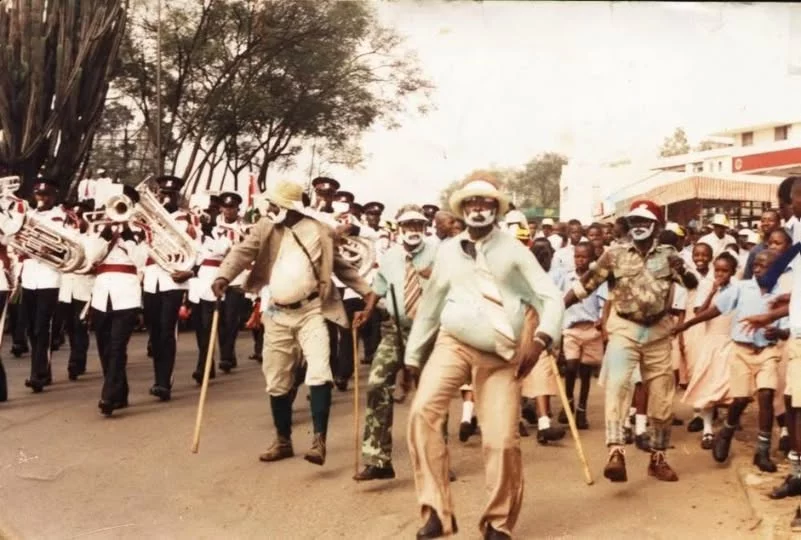
The performers dressed in military uniforms, wearing pith helmets and stuffing their clothes with pillows to appear like they had exaggerated backsides from riding the train and fake bellies from eating too much. It was comedy but, music historians say the song, or at least part of it, is a criticism of African soldiers who had collaborated with oppressive colonial authorities. Gachagwa akijua hii ataanza kuita watu Zangalewa.
In other words, what we later knew simply as “Zangalewa Dancers” wasn't just a bunch of grown men wearing pillows under their shirts and wobbling around with walking sticks.

There was history, military culture and political satire hiding underneath all that comedy.
The song became enormously popular in Cameroon. The album Zangalewa was named Record of the Year in Cameroon, and in 1993 the Union of African National Television and Radio Organizations recognised it as the best African record of the year.
The popularity travelled far beyond Cameroon.
West African DJs introduced the song to Colombia, particularly in Barranquilla and Cartagena, where it became known as “The Military” and “El Saca Lengua.” A Colombian version later became a dance-club hit.
And then, decades later, the song found an entirely new global audience.
In 2010, Shakira released “Waka Waka (This Time for Africa)” ahead of the FIFA World Cup in South Africa, incorporating elements of the Zangalewa chorus.
The song exploded worldwide.
But people quickly began asking:
Wait a minute... where did that chorus come from?
The members of Golden Sounds eventually learned about Shakira's version. Zé Bella said he was honoured that such a global superstar had used their music, while also making it clear that the original creators deserved royalties. The matter was subsequently settled out of court. Lazima walikula vizuri.
Interestingly, Golden Sounds eventually changed their own name to Zangalewa because the song had become so synonymous with them.
And the song's journey didn't stop there.
It continued to be used across Africa by soldiers, police officers, scouts, schoolchildren, sportsmen and their supporters, particularly during training, marching and rallying.
So when we were young and saw those “old men” with fake bellies, fake backsides, white beards and walking sticks shaking their bodies on a stage, we thought we were simply watching some hilarious entertainment.
We had no idea we were watching a little piece of Cameroonian military history, African wartime culture, colonial satire and one of the most travelled African songs in modern popular culture.
And now we know why that chorus sounded strangely familiar:
“Zamina mina eh eh...”
Yep.
That was Zangalewa before it became Waka Waka.
Translation:
"Tsaminamina" means: Come.
"Waka waka" means: Do it – as in, perform a task.
"Tsaminamina zangalewa" means: where do you come from?
"Wana" means: it is mine.
"Zambo" means: wait
Before we laugh at our childhood obsession with Zangalewa Dancers, there is actually a fascinating story behind the song that inspired the whole phenomenon.
“Zangalewa” was the title track of a 1986 album by Golden Sounds, a Cameroonian band whose members included Jean Paul Zé Bella, Victor Dooh Belley, Emile Kojidie and Annie Anzouer. Several of the male members were serving in the Cameroonian military, including the Presidential Guard — roughly equivalent to Kenya's Presidential Escort.
According to Zé Bella, the famous chorus originated from Cameroonian sharpshooters who had developed their own slang to communicate more effectively during the Second World War. Golden Sounds recreated the fast-paced style of military communication in their early arrangements of the song.
The lyrics were essentially directed at a soldier. The title “Zangalewa” has been linked to expressions in Cameroonian languages, including “Za engalomwa” in Fang, meaning “Who sent you?”, and “Za anga loé wa” in Ewondo, meaning “Who called you?”
The song itself mixed several languages and varieties, including French, Douala and Cameroonian Pidgin English.
And then came the dancing.
The performers dressed in military uniforms, wearing pith helmets and stuffing their clothes with pillows to appear like they had exaggerated backsides from riding the train and fake bellies from eating too much. It was comedy but, music historians say the song, or at least part of it, is a criticism of African soldiers who had collaborated with oppressive colonial authorities. Gachagwa akijua hii ataanza kuita watu Zangalewa.
In other words, what we later knew simply as “Zangalewa Dancers” wasn't just a bunch of grown men wearing pillows under their shirts and wobbling around with walking sticks.
There was history, military culture and political satire hiding underneath all that comedy.
The song became enormously popular in Cameroon. The album Zangalewa was named Record of the Year in Cameroon, and in 1993 the Union of African National Television and Radio Organizations recognised it as the best African record of the year.
The popularity travelled far beyond Cameroon.
West African DJs introduced the song to Colombia, particularly in Barranquilla and Cartagena, where it became known as “The Military” and “El Saca Lengua.” A Colombian version later became a dance-club hit.
And then, decades later, the song found an entirely new global audience.
In 2010, Shakira released “Waka Waka (This Time for Africa)” ahead of the FIFA World Cup in South Africa, incorporating elements of the Zangalewa chorus.
The song exploded worldwide.
But people quickly began asking:
Wait a minute... where did that chorus come from?
The members of Golden Sounds eventually learned about Shakira's version. Zé Bella said he was honoured that such a global superstar had used their music, while also making it clear that the original creators deserved royalties. The matter was subsequently settled out of court. Lazima walikula vizuri.
Interestingly, Golden Sounds eventually changed their own name to Zangalewa because the song had become so synonymous with them.
And the song's journey didn't stop there.
It continued to be used across Africa by soldiers, police officers, scouts, schoolchildren, sportsmen and their supporters, particularly during training, marching and rallying.
So when we were young and saw those “old men” with fake bellies, fake backsides, white beards and walking sticks shaking their bodies on a stage, we thought we were simply watching some hilarious entertainment.
We had no idea we were watching a little piece of Cameroonian military history, African wartime culture, colonial satire and one of the most travelled African songs in modern popular culture.
And now we know why that chorus sounded strangely familiar:
“Zamina mina eh eh...”
Yep.
That was Zangalewa before it became Waka Waka.
Translation:
"Tsaminamina" means: Come.
"Waka waka" means: Do it – as in, perform a task.
"Tsaminamina zangalewa" means: where do you come from?
"Wana" means: it is mine.
"Zambo" means: wait