

wakimani
Elder Lister
They arrived from Dubai on 13 December 2005, two men calling themselves Artur Margaryan and Artur Sargsyan, travelling on Armenian passports and announcing themselves as investors.
Within five weeks the Kenyan state had handed them work permits, helped register two companies — Kensington Holdings and Brother Link International — and begun treating them not as foreign businessmen but as men to be obeyed.
That is the part people forget. The Arturs were not powerful. They were given power. The interesting question was never who they were. It was who decided they should have a Runda mansion, a fleet of vehicles, VIP passes at Jomo Kenyatta International Airport, and ranks as deputy commissioners of police — and why.
The night the presses burned
It came to a head just after midnight on 2 March 2006.
Hooded men carrying AK-47 and G3 rifles stormed the Standard Group's offices at the I&M building in central Nairobi.
They cut the CCTV, switched KTN off air, seized computers and held the night staff. A second team hit the printing press on Likoni Road, broke in, and set the day's newspapers alight as they came off the rollers. The Irish Times correspondent described copies piled onto a bonfire.
The Daily Nation's later reconstruction named the units involved: the Kanga Squad, the Special Crime Prevention Unit, Nairobi CID detectives, and paramilitary commandos from the Quick Response Unit, under an assistant commissioner named Francis Njiru. The Kanga Squad itself had been built by CID director Joseph Kamau — six marksmen, created to hunt carjackers and contract killers, now sent to torch a newspaper.
And the Arturs were there. When a parliamentary report finally pieced the night together, it identified the raiders as police officers led by the two Armenians.
Here is the detail that tells you how the chain of command actually ran: the Commissioner of Police himself, Major General Hussein Ali, was kept in the dark.
By the account of officers close to him, Ali had already refused a State House order earlier that week to arrest journalists over a story about a claimed secret meeting between Kibaki and Kalonzo Musyoka. He advised the aggrieved parties to go to court. So the operation went around him.
When the Internal Security minister John Michuki was asked to explain, he gave the line that outlived everyone in the story: rattle a snake, he said, and be ready to be bitten. He called the raid a matter of national security — the Standard, he claimed, was about to publish material damaging to the government.
What were they really here for?
Run alongside the official story and you keep hitting the same shadow: cocaine.
In December 2004, police had seized roughly 1.1 tonnes of cocaine — put at around Ksh 6.4 billion — from refrigerated containers in Embakasi and a villa in Malindi. By the reporting that followed, and the WikiLeaks cables released years later, the Arturs' arrival was no coincidence.
A cable wired to Washington in March 2006 by the US embassy tied the brothers to a drug-trafficking syndicate and floated the theory that they had come — connected, the cable suggested, to the Akasha network — to recover that seized haul, operating under cover of a new anti-narcotics outfit.
A National Intelligence Service report, by several accounts, had already warned the government in writing that these were dangerous men, drug dealers, part of an international hit squad.
No one acted on the warning.
That is the second thing worth sitting with. The state was told, in advance, in writing, who these men were — and protected them anyway.
The protectors
So who was holding the umbrella?
The thread everyone followed led to Winnie Wangui Mwai. She was a serving civil servant, daughter of Mary Wambui — the woman whose claimed closeness to President Kibaki he disowned publicly more than once.
Winnie admitted, in a radio interview after the deportation, that Margaryan was the love of her life, that they had met through a friend in Dubai, that she expected to marry him. She insisted the brothers were honest men and the airport gun drama either never happened or was blown out of proportion.
The Sunday Nation then reported that on 4 June 2006 — four days before the airport blew up — the brothers had attended Mass at the Holy Family Basilica alongside Winnie, by then publicly described as Kibaki's daughter.
That report did what years of corruption stories never had: it moved the President to speak personally. He issued a statement insisting he had one family — Lucy and his sons — and that none of them had dealings with the foreigners, and demanded an apology.
The 2007 parliamentary inquiry, chaired by Paul Muite, went further than anyone in government wanted. It found that the Arturs had direct connections at the highest levels of the state. It named Mary Wambui and Winnie Wangui Mwai as close associates.
And it named Stanley Murage — permanent secretary and special adviser to the President, the man spoken of in low voices as the gatekeeper to State House — as a key player.
It recommended further inquiry into Michuki, into Head of the Civil Service Francis Muthaura, into the perennial Kamlesh Pattni, into businessman Raju Sanghani. It recommended Winnie Wangui be prosecuted and dismissed.
Almost none of it happened.
The commission that was built to fail
Kibaki's answer to all this, on 13 June 2006, was a commission of inquiry under former police commissioner Shadrack Kiruki, with Bishop Horace Etemesi and Ahmed Issack Hassan beside him. Eighty-four witnesses. Sittings from late June to August. A report on the President's desk by the end of August.
Read the US ambassador's verdict in his cable and you understand the exercise. William Bellamy called the government's reaction classically formulaic — find a scapegoat, form a committee, set a distant deadline, wait for public memory to fade. Legal action, he predicted, was unlikely.
He was right. The Kiruki report was handed to the President and never made public. Even Parliament's own investigators were never given a copy.
What leaked told its own story: the brothers were suspicious characters of uncertain nationality who should have been arrested; the police were savaged for ignoring Interpol tips that the men travelled on forged and stolen passports; the search of the Runda house was dismissed as amateurish, carried out hours late, after the Arturs had time to clean up.
Muthaura was told he should take personal responsibility for the failures beneath him. CID director Joseph Kamau was cleared.
But on the question that mattered — who in the political leadership was responsible — Kiruki said nothing. He did not rule on whether it was proper to deport the men rather than charge them. The deepest layer was left sealed.
And note who survived the purge. Kibaki suspended Kamau and ten others, suspended the KAA deputy managing director Naomi Cidi, suspended Winnie Wangui. The Kanga Squad — the unit that actually carried out the raid — was left intact.
There is a darker footnote from inside the Standard's own later reporting: that material handed to the commission had been doctored.
That the guns recovered at Runda reached the inquiry with their serial numbers filed off — to hide, the account claims, that they had come from the police armoury. And that Michuki personally took the witness box on behalf of the entire police force, spent about fifteen minutes there, and revealed nothing.
The deportation
The airport was the official trigger. On 8 June 2006 the brothers forced their way into a restricted customs area at JKIA, weapons visible, to push an associate's imported surveillance cameras through without paying duty. They assaulted officials. The public fury was immediate — foreigners breaking Kenyan law in a Kenyan airport while Kenyan officers stood down.
The state's response was telling. It raided Runda and produced a display of weapons, ammunition, government-plated vehicles and bulletproof vests. Then, on 9 June, Michuki and Hussein Ali had the brothers flown to Dubai. No charge. No court. No trial.
The 2007 parliamentary report read that deportation for what it was: not the closing of the case but the burial of it — orchestrated, it said, to shield the men from prosecution and to keep their real business in Kenya from ever being tested in open court.
What it adds up to
Strip away the cars and the ski masks and the love affair, and the Artur saga is not a story about two conmen. It is a story about a state that could be rented.
Two men with forged histories were given police rank, airport access, and the muscle of elite units built to fight Kenya's most dangerous criminals — and they used that machinery to burn a newspaper. When the intelligence service warned what they were, nothing moved.
When they finally went too far, they were not tried but flown out overnight. And the one document that might have named the people who made all of it possible was locked in a drawer, where it remains.
Martha Karua, as deputy leader of government business, blocked the motion to make the evidence public. Senior officials summoned to testify — Isaiah Osugo, David Kimaiyo, Patrick Lumumba of Gigiri — simply did not show, on instructions, the committee believed, from above.
Paul Muite has said for years that taxpayers paid for those inquiries and the public is owed the findings. Twenty years on, it has not been paid.
The names moved on. Muthaura went on to chair the Kenya Revenue Authority board. Pattni resurfaced in Zimbabwe. And in June 2026 the man who called himself Artur Sargsyan resurfaced too — now going by Artak Sargsyan, admitting the Kenyan names were aliases, claiming friendship with the late Joseph Kabila of DR Congo, and running, improbably, to become Prime Minister of Armenia.
Whatever the Arturs came to Kenya to collect, the record still doesn't say. What the record does show, plainly, is that the Kenyan state of 2006 was willing to break its own press, ignore its own spies, and seal its own inquiry to make sure the rest of us never found out
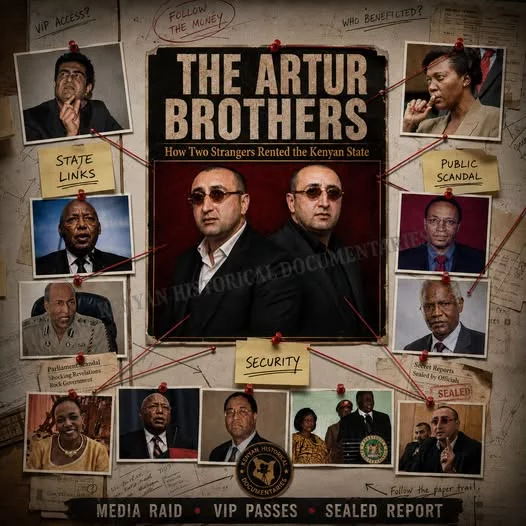
Within five weeks the Kenyan state had handed them work permits, helped register two companies — Kensington Holdings and Brother Link International — and begun treating them not as foreign businessmen but as men to be obeyed.
That is the part people forget. The Arturs were not powerful. They were given power. The interesting question was never who they were. It was who decided they should have a Runda mansion, a fleet of vehicles, VIP passes at Jomo Kenyatta International Airport, and ranks as deputy commissioners of police — and why.
The night the presses burned
It came to a head just after midnight on 2 March 2006.
Hooded men carrying AK-47 and G3 rifles stormed the Standard Group's offices at the I&M building in central Nairobi.
They cut the CCTV, switched KTN off air, seized computers and held the night staff. A second team hit the printing press on Likoni Road, broke in, and set the day's newspapers alight as they came off the rollers. The Irish Times correspondent described copies piled onto a bonfire.
The Daily Nation's later reconstruction named the units involved: the Kanga Squad, the Special Crime Prevention Unit, Nairobi CID detectives, and paramilitary commandos from the Quick Response Unit, under an assistant commissioner named Francis Njiru. The Kanga Squad itself had been built by CID director Joseph Kamau — six marksmen, created to hunt carjackers and contract killers, now sent to torch a newspaper.
And the Arturs were there. When a parliamentary report finally pieced the night together, it identified the raiders as police officers led by the two Armenians.
Here is the detail that tells you how the chain of command actually ran: the Commissioner of Police himself, Major General Hussein Ali, was kept in the dark.
By the account of officers close to him, Ali had already refused a State House order earlier that week to arrest journalists over a story about a claimed secret meeting between Kibaki and Kalonzo Musyoka. He advised the aggrieved parties to go to court. So the operation went around him.
When the Internal Security minister John Michuki was asked to explain, he gave the line that outlived everyone in the story: rattle a snake, he said, and be ready to be bitten. He called the raid a matter of national security — the Standard, he claimed, was about to publish material damaging to the government.
What were they really here for?
Run alongside the official story and you keep hitting the same shadow: cocaine.
In December 2004, police had seized roughly 1.1 tonnes of cocaine — put at around Ksh 6.4 billion — from refrigerated containers in Embakasi and a villa in Malindi. By the reporting that followed, and the WikiLeaks cables released years later, the Arturs' arrival was no coincidence.
A cable wired to Washington in March 2006 by the US embassy tied the brothers to a drug-trafficking syndicate and floated the theory that they had come — connected, the cable suggested, to the Akasha network — to recover that seized haul, operating under cover of a new anti-narcotics outfit.
A National Intelligence Service report, by several accounts, had already warned the government in writing that these were dangerous men, drug dealers, part of an international hit squad.
No one acted on the warning.
That is the second thing worth sitting with. The state was told, in advance, in writing, who these men were — and protected them anyway.
The protectors
So who was holding the umbrella?
The thread everyone followed led to Winnie Wangui Mwai. She was a serving civil servant, daughter of Mary Wambui — the woman whose claimed closeness to President Kibaki he disowned publicly more than once.
Winnie admitted, in a radio interview after the deportation, that Margaryan was the love of her life, that they had met through a friend in Dubai, that she expected to marry him. She insisted the brothers were honest men and the airport gun drama either never happened or was blown out of proportion.
The Sunday Nation then reported that on 4 June 2006 — four days before the airport blew up — the brothers had attended Mass at the Holy Family Basilica alongside Winnie, by then publicly described as Kibaki's daughter.
That report did what years of corruption stories never had: it moved the President to speak personally. He issued a statement insisting he had one family — Lucy and his sons — and that none of them had dealings with the foreigners, and demanded an apology.
The 2007 parliamentary inquiry, chaired by Paul Muite, went further than anyone in government wanted. It found that the Arturs had direct connections at the highest levels of the state. It named Mary Wambui and Winnie Wangui Mwai as close associates.
And it named Stanley Murage — permanent secretary and special adviser to the President, the man spoken of in low voices as the gatekeeper to State House — as a key player.
It recommended further inquiry into Michuki, into Head of the Civil Service Francis Muthaura, into the perennial Kamlesh Pattni, into businessman Raju Sanghani. It recommended Winnie Wangui be prosecuted and dismissed.
Almost none of it happened.
The commission that was built to fail
Kibaki's answer to all this, on 13 June 2006, was a commission of inquiry under former police commissioner Shadrack Kiruki, with Bishop Horace Etemesi and Ahmed Issack Hassan beside him. Eighty-four witnesses. Sittings from late June to August. A report on the President's desk by the end of August.
Read the US ambassador's verdict in his cable and you understand the exercise. William Bellamy called the government's reaction classically formulaic — find a scapegoat, form a committee, set a distant deadline, wait for public memory to fade. Legal action, he predicted, was unlikely.
He was right. The Kiruki report was handed to the President and never made public. Even Parliament's own investigators were never given a copy.
What leaked told its own story: the brothers were suspicious characters of uncertain nationality who should have been arrested; the police were savaged for ignoring Interpol tips that the men travelled on forged and stolen passports; the search of the Runda house was dismissed as amateurish, carried out hours late, after the Arturs had time to clean up.
Muthaura was told he should take personal responsibility for the failures beneath him. CID director Joseph Kamau was cleared.
But on the question that mattered — who in the political leadership was responsible — Kiruki said nothing. He did not rule on whether it was proper to deport the men rather than charge them. The deepest layer was left sealed.
And note who survived the purge. Kibaki suspended Kamau and ten others, suspended the KAA deputy managing director Naomi Cidi, suspended Winnie Wangui. The Kanga Squad — the unit that actually carried out the raid — was left intact.
There is a darker footnote from inside the Standard's own later reporting: that material handed to the commission had been doctored.
That the guns recovered at Runda reached the inquiry with their serial numbers filed off — to hide, the account claims, that they had come from the police armoury. And that Michuki personally took the witness box on behalf of the entire police force, spent about fifteen minutes there, and revealed nothing.
The deportation
The airport was the official trigger. On 8 June 2006 the brothers forced their way into a restricted customs area at JKIA, weapons visible, to push an associate's imported surveillance cameras through without paying duty. They assaulted officials. The public fury was immediate — foreigners breaking Kenyan law in a Kenyan airport while Kenyan officers stood down.
The state's response was telling. It raided Runda and produced a display of weapons, ammunition, government-plated vehicles and bulletproof vests. Then, on 9 June, Michuki and Hussein Ali had the brothers flown to Dubai. No charge. No court. No trial.
The 2007 parliamentary report read that deportation for what it was: not the closing of the case but the burial of it — orchestrated, it said, to shield the men from prosecution and to keep their real business in Kenya from ever being tested in open court.
What it adds up to
Strip away the cars and the ski masks and the love affair, and the Artur saga is not a story about two conmen. It is a story about a state that could be rented.
Two men with forged histories were given police rank, airport access, and the muscle of elite units built to fight Kenya's most dangerous criminals — and they used that machinery to burn a newspaper. When the intelligence service warned what they were, nothing moved.
When they finally went too far, they were not tried but flown out overnight. And the one document that might have named the people who made all of it possible was locked in a drawer, where it remains.
Martha Karua, as deputy leader of government business, blocked the motion to make the evidence public. Senior officials summoned to testify — Isaiah Osugo, David Kimaiyo, Patrick Lumumba of Gigiri — simply did not show, on instructions, the committee believed, from above.
Paul Muite has said for years that taxpayers paid for those inquiries and the public is owed the findings. Twenty years on, it has not been paid.
The names moved on. Muthaura went on to chair the Kenya Revenue Authority board. Pattni resurfaced in Zimbabwe. And in June 2026 the man who called himself Artur Sargsyan resurfaced too — now going by Artak Sargsyan, admitting the Kenyan names were aliases, claiming friendship with the late Joseph Kabila of DR Congo, and running, improbably, to become Prime Minister of Armenia.
Whatever the Arturs came to Kenya to collect, the record still doesn't say. What the record does show, plainly, is that the Kenyan state of 2006 was willing to break its own press, ignore its own spies, and seal its own inquiry to make sure the rest of us never found out