
Kiherehere ya Ruto itaharibu mradi wa Dangote

upepo

Elder Lister
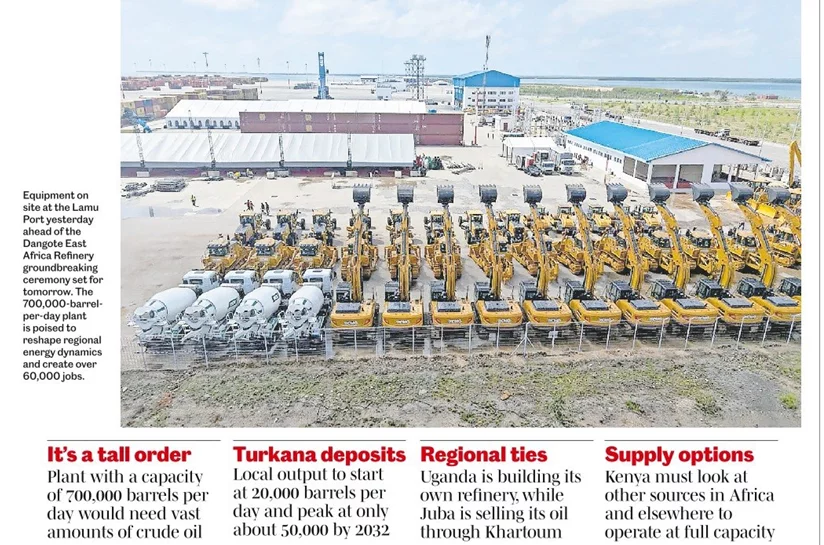
The Lamu refinery was supposed to be a regional project with the participation and investment of countries in the region. Ruto's rush, out of desperation to make political capital from the project, is being seen as a slight on our neighbors, hence their decision to proceed with their own refinery. Uganda and Tanzania have decided to build their own refinery. They have the oil, the pipeline, and the regional market. Removing Uganda's oil, Tanzanian Pipeline, and their combined regional market from the equation seriously weakens the rationale for the Dangote refinery.

Without guaranteed access to regional crude and markets, it will be difficult to convince investors about the viability of the project. Once more, Ruto has proved that he can be a liability beyond our borders. Of course, he intends to lie to the ignorant electorate that the refinery will solve all our energy problems, and they will believe him, even though we know that it does not. The main competitive advantage for such a refinery is access to regional crude and markets. With the exclusion of Uganda and Tanzania, the refinery will struggle to compete with operators in the Middle East and India, meaning the dream for cheaper oil in Kenya might remain just that.


1790663472283.webp
 
Last edited:
1790762956290.webp

AN APOLOGY TO ALIKO DANGOTE
Alhaji, I’m sorry.
People who have achieved your wealth and status are never wrong.
I should not have asked questions. I should not have wondered where the crude will come from, how a 700,000-barrel-a-day refinery would be fed, why the project moved from Tanga to Mombasa and then to Lamu, or what happened to the grand regional proposition with which this story began.
You know these things.
President William Ruto has already explained the proper attitude I should adopt.
This is a Sh2 trillion investment. It will create about 60,000 jobs. It will transform Lamu.
It will supply the region. It will industrialise Kenya.
And the President has made it abundantly clear that he will not allow legal, administrative or bureaucratic obstacles to stand in its way. Kenya is 100 per cent behind the Dangote project.
Who am I to object?
Indeed, I have been thinking about Munoo. In Mulk Raj Anand's Coolie, Munoo is a poor boy trying to sell a chicken.
He names his price, which the shopkeeper thinks is too high.
Munoo tries to explain. The shopkeeper does not appreciate explanations.
Munoo is beaten until he lowers the price.
He is beaten again. Eventually, he learns the great economic law of the poor:
the buyer is always right.
And suddenly I understand now.
I, too, had brought a chicken to market.
Only my chicken was a refinery site.
And you, Alhaji, were the buyer.
So I apologise.
I should have understood that the wealthy man has a different relationship with math.
When the investment is Sh2 trillion, the important question is not what it costs.
When the project promises 60,000 jobs, the important question is not when they arrive.
When the refinery is 700,000 barrels a day, we should not be so vulgar as to ask how many days it will actually operate at that capacity.
These are questions for people who have not made it.
And besides, the President is getting nothing from this except Kenya's development.
Nothing. No shareholding. No commission. Not even a little appreciation for having cleared the bureaucratic undergrowth.
He is simply standing there, selflessly waving the national flag while Sh2 trillion enters the country.
Previous administrations, we are told, had their own ideas about Dangote's cement ambitions.
This time, apparently, the businessman is simply being allowed to invest.
No demands. No middlemen. No kickback.
Indeed, this is what makes you such a refreshing African capitalist.
You do not need to pay the sort of appreciation that people sometimes associate with Chinese infrastructure deals.
You simply arrive with your billions. And Kenya says: Thank you, Alhaji.
Except that I have got the transaction backwards.
It is not Kenya that should be thanking you. You should be thanking Kenya.
And that, Alhaji, is where my little thank-you note comes in.
Suppose, purely hypothetically, that after being allowed to invest Sh2 trillion in Kenya, you decided that the least you could do was send the people who made it possible a modest expression of gratitude.
Just 0.5 per cent as a little thank-you. A token of appreciation.
Except that 0.5 per cent of Sh2 trillion is Sh10 billion.
And suddenly you understand why a thank-you note of that magnitude might distort Kenya's election next year.
Fortunately, Alhaji, you don't do such things. And our government does not ask.
So I withdraw my questions. I withdraw my suspicions.
I have finally understood my place in the transaction.
I am Munoo Mundu. I brought the chicken.
You set the price.
I can come back later for my payment.
 
View attachment 116563
AN APOLOGY TO ALIKO DANGOTE
Alhaji, I’m sorry.
People who have achieved your wealth and status are never wrong.
I should not have asked questions. I should not have wondered where the crude will come from, how a 700,000-barrel-a-day refinery would be fed, why the project moved from Tanga to Mombasa and then to Lamu, or what happened to the grand regional proposition with which this story began.
You know these things.
President William Ruto has already explained the proper attitude I should adopt.
This is a Sh2 trillion investment. It will create about 60,000 jobs. It will transform Lamu.
It will supply the region. It will industrialise Kenya.
And the President has made it abundantly clear that he will not allow legal, administrative or bureaucratic obstacles to stand in its way. Kenya is 100 per cent behind the Dangote project.
Who am I to object?
Indeed, I have been thinking about Munoo. In Mulk Raj Anand's Coolie, Munoo is a poor boy trying to sell a chicken.
He names his price, which the shopkeeper thinks is too high.
Munoo tries to explain. The shopkeeper does not appreciate explanations.
Munoo is beaten until he lowers the price.
He is beaten again. Eventually, he learns the great economic law of the poor:
the buyer is always right.
And suddenly I understand now.
I, too, had brought a chicken to market.
Only my chicken was a refinery site.
And you, Alhaji, were the buyer.
So I apologise.
I should have understood that the wealthy man has a different relationship with math.
When the investment is Sh2 trillion, the important question is not what it costs.
When the project promises 60,000 jobs, the important question is not when they arrive.
When the refinery is 700,000 barrels a day, we should not be so vulgar as to ask how many days it will actually operate at that capacity.
These are questions for people who have not made it.
And besides, the President is getting nothing from this except Kenya's development.
Nothing. No shareholding. No commission. Not even a little appreciation for having cleared the bureaucratic undergrowth.
He is simply standing there, selflessly waving the national flag while Sh2 trillion enters the country.
Previous administrations, we are told, had their own ideas about Dangote's cement ambitions.
This time, apparently, the businessman is simply being allowed to invest.
No demands. No middlemen. No kickback.
Indeed, this is what makes you such a refreshing African capitalist.
You do not need to pay the sort of appreciation that people sometimes associate with Chinese infrastructure deals.
You simply arrive with your billions. And Kenya says: Thank you, Alhaji.
Except that I have got the transaction backwards.
It is not Kenya that should be thanking you. You should be thanking Kenya.
And that, Alhaji, is where my little thank-you note comes in.
Suppose, purely hypothetically, that after being allowed to invest Sh2 trillion in Kenya, you decided that the least you could do was send the people who made it possible a modest expression of gratitude.
Just 0.5 per cent as a little thank-you. A token of appreciation.
Except that 0.5 per cent of Sh2 trillion is Sh10 billion.
And suddenly you understand why a thank-you note of that magnitude might distort Kenya's election next year.
Fortunately, Alhaji, you don't do such things. And our government does not ask.
So I withdraw my questions. I withdraw my suspicions.
I have finally understood my place in the transaction.
I am Munoo Mundu. I brought the chicken.
You set the price.
I can come back later for my payment.
 
Back
Top