

kymnjoro
Elder Lister
The Shamba Genesis (1982)
Long before the term “logistics supply chain” became a corporate buzzword in East Africa, Multiple Hauliers (EA) Limited was forged in 1982 as a highly insular, family-run trucking enterprise. Starting with only a handful of modest cargo units, the firm was built to exploit a massive, unaddressed vacuum: the raw bulk haulage demands of an economically awakening East African hinterland.The Baryan Family Dynasty
The architects behind this logistics juggernaut were the Baryan family. Led by Managing Director Rajinder Singh Baryan, alongside Manvir Singh Baryan and co-director Tarlochan Singh Chajja Singh (Heer), the family ran the company as a tightly held, opaque private fiefdom. As cash flows boomed in the 1990s and 2000s, the family expanded its footprint into luxury automotive retail, establishing Porsche Centre Nairobi Limited—an elite lifestyle play financed by the underlying muscle of their heavy transport cash cow.The Fuel & Cement Moat
At its peak, Multiple Hauliers didn’t just compete in the market; they were the market. They established an ironclad monopoly over high-yield B2B industrial contracts. They became the primary, irreplaceable logistics backbone for regional cement titans (Bamburi Cement, Tororo Cement), multi-national oil marketers, and high-value cross-border freight.To understand the sheer scale of the Multiple Hauliers moat, one must look at how the Northern Corridor was carved up. In the 1990s and 2000s, long-haul trucking in East Africa was highly fragmented, populated by thousands of small-scale single-truck “hustlers” and mid-tier transporters. Yet, when it came to the massive, institutional-grade industrial distribution contracts that dictated regional trade, Multiple Hauliers commanded an estimated 35% to 40% market share of the total high-yield bulk and wet-cargo freight moving from the Port of Mombasa into the hinterland.
This commanding position allowed them to comfortably choke out their closest institutional rivals, creating distinct competitive dynamics across their core segments:
- The Cement Hegemony vs. Mid-Tier Transporters: In the dry-bulk segment, Multiple Hauliers was the premier logistics partner for Bamburi Cement and Tororo Cement. While regional competitors like Busha Logistics, Civicon, and Gidoomal Logistics captured piecemeal local distribution routes, Multiple Hauliers secured the primary, multi-year cross-border contracts.
- The Fuel Moat vs. High-Spec Rivals: Moving petroleum and wet cargo required strict international health, safety, and environmental (HSE) compliance—a barrier to entry that standard truckers could never clear. Multiple Hauliers built high-spec fuel fleets to service multi-national majors like Shell (BP/Vivo Energy), TotalEnergies, and KenolKobil. Their main corporate competitor in this highly regulated asset-heavy space was Siginon Group (backed by the Moi-era political elite). While Siginon and elite operators like Haji Transporters or Achelis held strong positions in aviation ground handling and regional transit, Multiple Hauliers consistently outpaced them on pure road-tanker volume, maintaining the largest single fleet of fuel-compliant prime movers in East Africa.
- The Cross-Border Freight Domain: On the long-haul transit routes extending into Uganda, Rwanda, and the Democratic Republic of Congo (DRC), global logistics conglomerates like Bolloré Transport & Logistics (now AGL) and DHL dominated the high-end clearing, forwarding, and supply-chain management. However, when these global giants needed the actual raw, heavy asset muscle to move thousands of containers out of Mombasa, they routinely sub-contracted the physical long-haul transport to Multiple Hauliers.
The Scion and the Showroom: Living Large on Borrowed Liquidity
No corporate tragedy in the annals of Kenyan capitalism is complete without the archetype of generational hubris. As Multiple Hauliers was structurally engineering its own demise through a toxic cocktail of unserviceable dollar debt, the outward-facing optics of the Baryan family dynasty remained stubbornly, obscenely gilded.At the center of this narrative sat the family’s high-octane vanity play: Porsche Centre Nairobi Limited.
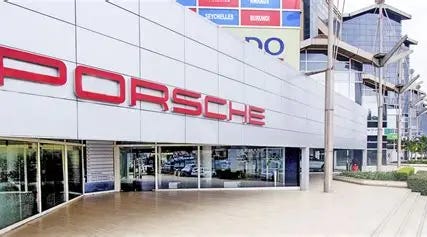
While the enterprise’s heavy-duty logistics arm was suffocating under terminal balance sheet decay, the family branched into the ultra-luxury automotive retail sector, opening a state-of-the-art Porsche franchise showroom along Mombasa Road. The playground was designed to be spearheaded by the next generation of the dynasty, notably Manvir Singh Baryan—a scion who split his time between high-profile corporate steering and burning rubber as a competitive continental rally driver.
For value investors, the corporate architecture of the Porsche franchise is a chilling masterclass in the weaponization of inter-company guarantees:
- The Funding Illusion: The luxury lifestyle play was not funded by organic, high-margin retail success. Instead, it was floated on the back of the underlying heavy transport cash cow. Millions of shillings in syndicated lines and bank credit—meant to maintain a depreciating log of logistics machinery—were subtly diverted or leveraged to prop up an elite, low-volume automotive showroom.
- The Guarantee Trap: To grease the wheels of their massive USD 134 million to USD 138 million forex loan facilities, the Baryan family systematically used Porsche Centre Nairobi to issue sweeping corporate guarantees and security instruments to tier-1 lenders like NCBA Bank. The family effectively cross-collateralized their luxury hobby with their industrial infrastructure, ensuring that when the logistics engine sputtered, the Porsche showroom would be dragged into the legal crosshairs.
- Living Large on Borrowed Time: While long-haul drivers on the Northern Corridor were facing stalled maintenance and grounded fleets, the elite showroom served as a mirage of immense generational wealth. It was a classic frontier-market operational mask: using the glitz of imported German sports cars to project absolute solvency to local banking syndicates, even as the core logistics business faced an apocalyptic KSh 14.4 billion negative equity black hole.
The Visual Footprint
For over two decades, the company’s visual dominance was absolute. You could not drive down the Mombasa–Nairobi–Kampala highway without encountering their distinct, miles-long convoys of maroon prime movers. They were the undisputed, bulletproof “Kings of the Road.”Part 2: Early Shareholding Battles & The “Original Sin”
The State-Backed Squeeze-Out
Every massive corporate collapse invariably exposes a dark “original sin” buried deep within the foundation. For Multiple Hauliers, this skeleton crawled out of the closet when the empire began fracturing under insolvency. Businessman Mungai Kariuki took his historical grievance straight to the courts, lodging a highly explosive petition during the high-stakes restructuring battles.The Claims in Court
In his court filings, Kariuki laid out a retrospective saga of raw corporate betrayal. He asserted that he was a legitimate, original founding partner when Multiple Hauliers was incorporated in 1982. He alleged that once the logistics business began showing signs of generating immense generational wealth, his co-founders weaponized high-ranking police officers and raw state intimidation to terrify him. Under the threat of state coercion, Kariuki claimed he was forcibly squeezed out and pressured to walk away from his equity stake without a single shilling in compensation.The Legal Gambit
By dropping this toxic ownership dispute right into the modern bankruptcy wars, Kariuki’s legal strategy was clear: he wanted the High Court to establish that the Baryans never fully or legally owned the underlying corporate vehicle to begin with. This added a highly volatile layer of title disputes, severely complicating the ability of predatory banks to cleanly seize and liquidate the firm’s core assets.Part 3: The Balance Sheet Mirage & The Creditor Carnage
The Origin of the KSh 7.2 Billion NCBA Exposure: The Forex Syndicated Loan Trap
The massive, unserviceable debt mountain that ultimately crushed Multiple Hauliers was not built through standard, local over-the-counter commercial bank overdrafts. Instead, it was the byproduct of a sophisticated, hyper-leveraged international capital structure—a multi-layered USD 134 million to USD 138 million foreign currency (forex) syndicated loan facility that eventually turned into a terminal liquidity trap.During its aggressive asset-accumulation era, Multiple Hauliers bypassed standard financing limits by assembling a powerful consortium of regional, local, and international private credit institutions to fund its senior and high-yield mezzanine debt tiers:
- The Senior Lenders Consortium: The primary senior secured debt facilities were anchored by The Standard Bank of South Africa Limited alongside its local Kenyan subsidiary, Stanbic Bank Kenya Limited. Acting as a core senior arranger and lender within this exact syndication block was NIC Bank Limited (now NCBA Bank). This high-octane legacy exposure is the direct origin story of how NCBA became the lead anchor creditor left holding the largest, most toxic bag.
- The Mezzanine Credit Layer: Sitting immediately beneath the senior debt was a high-yield mezzanine facility provided by Barak Fund, a prominent international specialized trade finance and private credit fund. This layer carried punishingly steep interest rates in exchange for flexible capital.
- Specialized Development Dollar Lines: To aggressively expand its cross-border footprint and fund its industrial manufacturing arms, Multiple Hauliers went outside local commercial structures to secure direct hard-currency lines. This included a USD 12.5 million facility from the Trade and Development Bank (TDB / formerly PTA Bank) explicitly earmarked for importing heavy plant machinery and clinker, alongside secondary mezzanine facilities from international private credit outfits like the TriLinc Global Impact Fund.
The Structural Break: Dollar Debt vs. Shilling Revenue
This complex cross-border financial engineering created the definitive balance sheet mirage. While the Baryans successfully acquired thousands of cutting-edge trucks, their capital structure possessed a fatal structural flaw: total currency mismatch.Every single cent of their multi-million-dollar debt service to NCBA, Standard Bank, and Barak Fund was hard-pegged to the US Dollar (USD). However, the day-to-day cash flows generated by their fleet on the Northern Corridor were strictly trapped in local East African currencies (KES, UGX, RWF).
When macroeconomic shocks hit and the Kenyan Shilling entered historic, unprecedented depreciation cycles, the cost of purchasing hard USD from the market to service these syndicated facilities skyrocketed exponentially. Multiple Hauliers had structurally designed its own insolvency, handing NCBA Bank a front-row seat to the eventual multi-billion-shilling corporate foreclosure.
The Verified Reality of the Carnage
When the music finally stopped, the scale of the leverage was terminal. The official financial position filed by the Official Receiver revealed a apocalyptic asset-liability mismatch:Financial Metric (KSh Billion)
Total Assets: KSh 17.0 B
Verified Liabilities: KSh 31.4 B
Net Equity Position: (KSh 14.4 B)
The KSh 17 Billion Asset Base
To understand the legal gridlock paralyzing the courts, one must look at what actually remains of the Multiple Hauliers empire. This KSh 17.0 billion asset ledger is heavily degraded, trapped under cross-border litigation, and split into three distinct fronts:- The Depreciating Log (The Fleet & Machinery): The core operational assets consist of hundreds of heavy-duty prime movers, specialized bulk-silo tankers, and high-spec road tankers historically deployed for multinational fuel and cement contracts.
- Strategic Real Estate & Logistics Depots: The company retains a highly valuable physical footprint across the Northern Corridor. This includes prime container yard storage facilities near the Port of Mombasa, the Nairobi/Athi River operations hub designed to service regional cement zones, and various transit holding stations trailing toward the Malaba border. These properties are the primary targets for tier-1 banks seeking immediate foreclosure.
- Corporate Fiefdoms & Inter-Company Guarantees: A critical component of the asset war involves the family’s luxury automotive arm, Porsche Centre Nairobi Limited. While legally distinct, the entity is completely entangled in the bankruptcy proceedings because its assets and corporate guarantees were systematically weaponized by the Baryan directors to secure the haulier’s multi-billion-shilling loans.
The Creditor Ledger: Who is Owed What
A granular breakdown of the major verified creditors left holding the bag exposes a vast cross-section of institutional casualties:- NCBA Bank Kenya PLC: The lead anchor lender, exposed to a staggering KSh 7.2 billion in unpaid syndicated lines and asset financing.
- Co-operative Bank of Kenya: Holding an exposed line of KSh 1.2 billion primarily tied to operational capital lines.
- Synergy Credit Limited: A niche, specialized asset finance firm left exposed to the tune of KSh 500 million (KSh 0.5 B) in high-yield short-to-medium term credit.
- Diro Advocates LLP: The prominent legal firm left chasing KSh 200 million (KSh 0.2 B) in defaulted fees for defensive legal work done to stall creditors.
- National Social Security Fund (NSSF): Left holding an unpaid statutory claim of KSh 10 million (KSh 0.01 B).
Part 4: The SGR Guillotine & Operational Decay
The State-Backed Infrastructure Disruption
Just as the Baryans were suffocating under their currency mismatch, the government delivered the ultimate macroeconomic death blow: the commissioning of the Standard Gauge Railway (SGR) from the Port of Mombasa to Nairobi. In a heavy-handed bid to make the Chinese-funded railway viable, the state issued aggressive policy mandates forcing a massive chunk of port cargo onto the rail tracks. Overnight, the highly lucrative long-haul container market for road hauliers evaporated.The Freight Rate Collapse
With the SGR hoarding container traffic, thousands of independent trucks flooded the remaining open road markets out of sheer desperation. Freight rates collapsed across the region. Multiple Hauliers found itself stranded with an aging, high-maintenance fleet, over 1,500 employees, staggering corporate overheads, and vanishingly thin operational margins. Virtually every shilling of revenue generated was immediately swallowed up to pay penal interest rates, leaving absolutely nothing to fund basic truck maintenance and fuel.To the Boardlot Community: Multiple Hauliers was a powerhouse that fell victim to a classic corporate trap: funding long-term, local-currency infrastructure assets with short-term, foreign-currency (USD) syndicated debt. When state-backed disruption (SGR) hit, they had zero margin for error.
Look at your own portfolios today: which listed or private companies are currently masking deep currency mismatches and high leverage under the guise of “aggressive expansion”? Let’s discuss in the comments section below.
Part 5: The Insolvency War & The White Knight Mirage (2021–2025)
The Administration Standoff
On June 7, 2021, a syndicate of exhausted creditors ran out of patience and slapped Multiple Hauliers with a liquidation petition, successfully placing the giant under court-ordered administration. For nearly three years, NCBA-appointed joint administrators tried to untangle the web, but by April 2024, they resigned in frustration. Sensing a terminal collapse, the High Court stepped in on September 2024 and appointed the Official Receiver (operating under the Business Registration Service) to steer a radical corporate rescue plan.The Amava White Knight Mirage
The Official Receiver’s entire survival strategy rested on a South African private equity player: Amava Group Capital (Pty) Ltd. Amava had signed a term sheet promising to inject USD 8.5 million of fresh equity liquidity to stabilize the fleet’s daily operations and pacify creditors. The court directed the Official Receiver to oversee the completion of this investment deal by December 2024.To shield this transaction, the High Court intervened again in February 2025, extending the administration period by another six months. The court issued sweeping injunctive relief under Section 594(1)(b) of the Insolvency Act, barring KCB Bank, Co-operative Bank, Prime Bank, and other secured lenders from executing a chaotic, individual fire sale of the company’s remaining assets pending the completion of the Amava transaction.
The Court of Appeal Guillotine (September 2025)
But the entire rescue process was aggressively re-engineered in September 2025 when NCBA Bank launched a decisive counter-strike at the Court of Appeal. NCBA argued a cold, hard legal truth: the Official Receiver’s narrow focus on pushing through the Amava deal left the remaining multi-billion-shilling asset base completely unprotected and susceptible to asset dissipation under the backdoor control of the original Baryan directors.A three-judge bench of the Court of Appeal agreed with the financial giant. They issued a stay order suspending the appointment of the Official Receiver and freezing all associated High Court protections. The appellate court held that the appointment had bypassed strict procedural requirements and disregarded NCBA’s explicit statutory right under the Insolvency Act to protect its KSh 7.2 billion debt line. This stay order effectively froze the Amava transaction in its tracks, plunging the entire rescue back into absolute legal uncertainty.
Part 6: The Downstream Carnage: The Sacrifice of LSHS
The Supply Chain Domino Effect
When an economic titan like Multiple Hauliers stops paying its bills and grounds its fleet, the shockwaves inevitably travel down the supply chain to crush its primary industrial contractors. Enter Labh Singh Harnam Singh Limited (LSHS)—Kenya’s oldest, most celebrated coach and commercial bus bodybuilder.For decades, LSHS’s sprawling 5-acre industrial plant in Syokimau, Machakos County, was the fabrication hub where Multiple Hauliers’ massive fleet of flatbeds, tippers, rigid containers, and specialized fuel tankers were manufactured, customized, and repaired.
The KCB Foreclosure
As Multiple Hauliers went cold, LSHS’s cash flow evaporated. Left with specialized overheads, heavy manufacturing equipment, and a dried-up client ledger, LSHS defaulted on a KSh 1.1 billion loan owed to KCB Group.The corporate contagion was complete:
- On February 4, 2025, the High Court placed LSHS under administration, appointing joint administrators Ponangipalli Venkata Ramana Rao and Swaroop Rao Ponangipalli to seize control from the directors.
- By August 26, 2025, all rescue attempts for Kenya’s premier fabricator officially stalled. Phillips International Auctioneers, acting for KCB and the administrators, invited sealed public bids for the total asset-stripping sale of LSHS’s entire Syokimau plant—including its specialized machinery, interconnected godowns, and fabrication yards.
The Battle of Legal Minds: The Multiple Hauliers Insolvency Wars
If the KSh 31.4 billion collapse of Multiple Hauliers East Africa Limited is a textbook masterclass in the dangers of macroeconomic shifts and currency mismatches, the resulting bankruptcy proceedings have become a multi-front theater of war for Kenya’s elite commercial lawyers.This isn’t a straightforward asset liquidation. It has evolved into a complex legal chess match spanning the Milimani Commercial Courts, the Court of Appeal, and international arbitration panels in London.
As the battle lines are drawn over the remnants of a KSh 17.0 billion asset base, the case has pitted top-tier insolvency practitioners, Senior Counsel, and global dispute resolution experts against one another.
The Corporate Defenders: Shielding the Baryan Dynasty
The Litigants: MG Holdings Limited, Rajinder Singh Baryan, Tarlochan Singh Heer, and Manvir Singh Baryan.The Legal Counsel:
- Kiarie Kariuki (Lead Advocate, Kiarie Kariuki, Atieno Obura & Partners, Mombasa)
- Kennedy O. Owiti (Partner, Owiti, Otieno & Ragot, Kisumu)
The Strategy:
Facing a combined multi-bank assault, the legal team representing the Baryan family has executed a sophisticated, defensive strategy anchored on jurisdictional maneuvering. Rather than simply absorbing the insolvency petitions in Nairobi, Kariuki and Owiti went on the offensive. They initiated a massive KSh 88 billion counter-claim via the London Court of International Arbitration (LCIA), alleging that the banking syndicate breached its contractual duties by failing to disburse critical capital facilities, which systematically starved the logistics giant of liquidity.Back home in the High Court, they successfully weaponized Section 7 of the Arbitration Act. In October 2025, they secured sweeping interim protective measures from High Court Judge Mulwa, arguing that allowing banks to aggressively enforce local corporate guarantees or appoint replacement administrators would entirely dismantle the company and undermine the ongoing, multi-billion-shilling London arbitration. It was a masterstroke in litigation stalling, momentarily freezing the lenders in their tracks.
The Banking Syndicate: The Aggressive Creditor Strike Force
The Litigants: NCBA Bank Kenya PLC (owed KSh 7.2B) and Barak Fund SPC Limited.The Legal Counsel:
- Kamau Karori, SC (Senior Counsel & Lead Commercial Strategist, IKM Advocates / Iseme, Kamau & Maema)
- Cecil Kuyo (Dispute Resolution & Restructuring Partner, Bowmans Kenya / Coulson Harney LLP)
The Strategy:
Representing NCBA Bank—which is chasing an exposure that has ballooned to over KSh 12.7 billion including accrued interest—Kamau Karori, SC, and Cecil Kuyo have continuously fought to strip the Baryans of their protective judicial shields.The lenders’ legal minds launched a decisive counter-strike at the Court of Appeal in September 2025. They argued a cold, strict interpretation of the Insolvency Act: by narrowing the focus to a speculative USD 8.5 million South African rescue package (the Amava deal), the court was leaving the remaining asset base unprotected and highly vulnerable to dissipation under the backdoor control of the original directors.
The Court of Appeal agreed with their statutory interpretation, suspending the Official Receiver’s mandate and upholding the tier-1 banks’ explicit legal right to protect their massive credit lines. They followed this up by aggressively filing to stay the High Court’s arbitration-linked injunctions, maintaining that a secured creditor’s right to realize securities cannot be held hostage by a distant, pending London tribunal scheduled for 2027.
The Independent Claimants: Fighting For Fees
The Litigant: Diro Advocates LLP (owed KSh 200 Million).The Legal Counsel: Self-Represented.
The Strategy:
Adding a fascinating twist to this legal web is Diro Advocates LLP. In a rare turn of events, the prominent law firm transitioned from being the company’s historical defense shield to one of its registered top-five verified creditors.Chasing KSh 200 million in outstanding legal fees accumulated during years of defensive litigation against early insolvency petitions, Diro Advocates operates on a distinct, self-interested track. Their legal minds are heavily focused on the statutory asset-distribution pool. Because professional and legal administration fees are legally granted first-claim status during asset realization under Kenyan insolvency frameworks, Diro Advocates’ position ensures that whatever the outcome of the war between the Baryans and the tier-1 banks, the legal minds who engineered the early defenses have a front-row, protected seat at the liquidator’s table.
The High-Stakes Precedent
The Multiple Hauliers case has evolved past a simple dispute over defaulted logistics loans. It has become a battleground for complex legal theory:- Can a debtor use the shield of international arbitration clauses to permanently block local banks from seizing physical collateral under Kenyan law?
- Does a court-appointed Official Receiver override the explicit statutory rights of a secured syndicated lender to install their own chosen administrator?

