America and Israel Strikes Iran : Supreme Leader Ali Khamenei Dead

Who do you support in the current conflict?

  • Iran

  • Israel & USA

  • Neither


Results are only viewable after voting.
1774845033155.webp
 

Africa is hurting again from a global crisis it had no part in starting​


LAGOS, Nigeria (AP) — Lagos taxi driver Adegbola Isaac went to the gas station twice last weekend. Each time, the price in the Nigerian city had climbed further and hit 1,350 naira ($0.99) per liter, a nearly 35% increase since the Iran war started. That’s wiped out most of his daily profit.

“It is hitting hard,” Isaac told The Associated Press.

Like many people across the world, Isaac is one of millions across Africa who are reeling from the economic impacts of the faraway conflict in the Middle East, which began Feb. 28 with joint U.S.-Israeli strikes on Iran.

For many Africans, the fuel price hike because of the Strait of Hormuz being largely closed off worsens the hardships they already struggle with in some of the world’s poorest households.

The latest shock also isn’t isolated.

 
US Special Operations forces touchdown in Middle East as Trump prepares for possible escalation

US troops could secure Strait of Hormuz, target Iran's Kharg Island oil hub, or Isfahan nuclear site, adding to growing military presence in the region.

Several hundred US Special Operations forces have arrived in the Middle East, joining thousands of Marines and Army paratroopers as President Donald Trump weighs his next move in the war with Iran, according to a report by The New York Times.

The commandos, including Army Rangers and Navy SEALs, have not been assigned specific missions, officials said to the newspaper, speaking on condition of anonymity.

As specialised ground troops, they could be deployed to help safeguard the Strait of Hormuz, which Iran has effectively closed, or take part in a mission targeting Kharg Island, Iran's key oil hub in the Gulf.

They could also be used in operations aimed at Iran's highly enriched uranium at the Isfahan nuclear site.

The deployment adds to around 2,500 Marines and 2,500 sailors who have recently arrived in the region.


Photos show heavily damaged US radar jet at Saudi base​


1774854409029.webp


Verified pictures show a US command and control aircraft has been destroyed at an air base in Saudi Arabia.

The pictures appear to have been first shared by a Facebook page carrying US military news. They show the E-3 Sentry aircraft appears to have been split in two.

We've confirmed the photos were taken at the Prince Sultan air base about 100km (62 miles) south-east of the Saudi capital Riyadh. Features seen in the pictures, including pylons, storage units and markings on paved areas, matched with satellite imagery.

US Central Command has not yet publicly commented on the incident. The BBC has asked for comment.

On Friday a US official told Reuters that 12 US personnel had been wounded, two of them seriously, in an Iranian military attack on the air base. The Wall Street Journal newspaper reported that at least two US refuelling aircraft were also damaged.

1774854490792.webp

The E-3's radar allows it to track potential targets at long ranges (file image)


The War of the Algorithm​

Artificial intelligence makes it possible to target an enemy’s leaders and conduct mass surveillance.

The war in the Middle East represents a new model of conflict: the priority objective is no longer to destroy military units or conquer territory, but to identify, locate, and eliminate specific people within the chain of command, the scientific apparatus, and political leadership. Although “decapitation” has been in military and intelligence doctrine for decades, what’s different is the possibility of industrializing it through data, sensors, ubiquitous surveillance, and algorithmic systems capable of cross-referencing information at speed and scale.

The Middle East has been the most visible laboratory. Israel uses AI to process intelligence, intercept communications, and conduct surveillance to generate targets “faster.” This is not a minor detail: when Microsoft, Google, Amazon, or OpenAI technology enters the operational cycle of a war, the distance between Silicon Valley and the battlefield ceases to be conceptual and becomes contractual.

Battles over contracts are erupting, most notably the recent standoff between Anthropic and the Pentagon. Anthropic signed a $200 million contract with the Department of Defense last summer, making Claude the only AI model available on classified US military networks.


Trump ‘wants to take the oil in Iran’ and considers seizing Kharg Island​

US President says taking oil is his 'favourite' plan but that 'stupid people' in America are questioning it

Donald Trump has said he wants ⁠to “take the ⁠oil ⁠in Iran” and ⁠is considering the option of seizing the export ‌hub of ‌Kharg Island.

The US President, in an interview with the Financial Times, said his “preference” would be to take the oil under plans similar to its aims in Venezuela, where it hopes to control the industry.

“To be honest with you, my favourite thing is to take the oil in Iran but some stupid people back in the US say, ‘Why are you doing that?’ But they’re stupid people,” he said.

Speaking about whether or not the US could seize Kharg Island, he said: “Maybe we take Kharg Island, maybe we don’t. We have a lot of options,” adding they could “take it very easily”.

Kharg Island is Iran’s main oil terminal in the Persian Gulf and handles roughly 90 per cent of Iran’s 1.7 million barrels of crude exports per day, making it one of the country’s most important targets.

 
☝️Trump might take the Island and later claim that this was the goal from the beginning and all the bluster about regime change was just "strategic ambiguity". #WIN #Off-Ramp #NoTACO 😁😁😁😁
 

Trump Is Willing to End the War Without Reopening Hormuz​


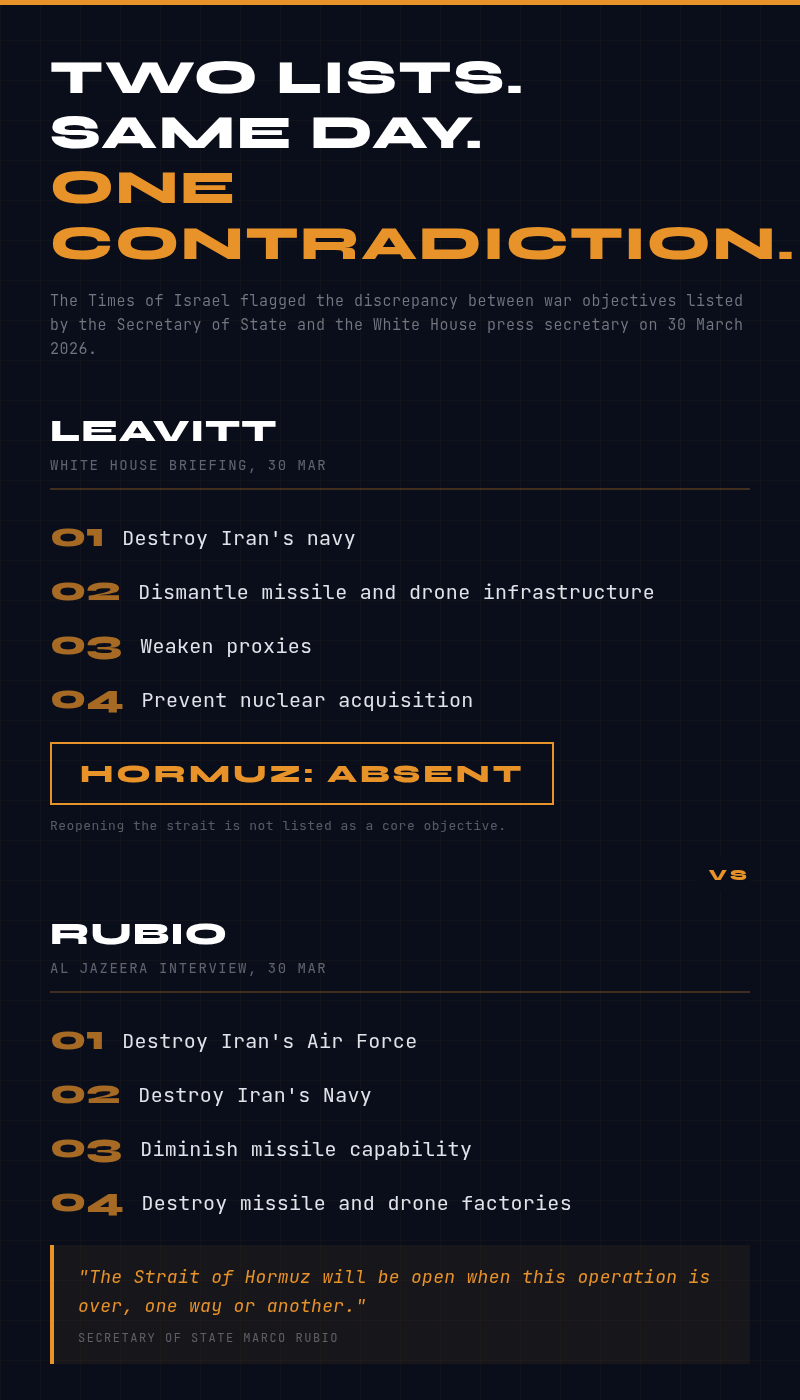
The White House listed four war objectives. Reopening the strait is not one of them. The Secretary of State says it will reopen. Gulf allies say the war cannot end without it. Iran says no negotiations have happened. Brent is up 55% in March.


infographic-objectives.png


The Wall Street Journal reported on 30 March, citing administration officials, that Trump has told aides he would end the military campaign against Iran even if the Strait of Hormuz remains largely closed. The mission to pry open the chokepoint "would push the conflict beyond his timeline of four to six weeks" (WSJ, 30 Mar). Operation Epic Fury is on Day 31. The four-week mark has passed. The six-week window closes 11 April.

White House press secretary Leavitt confirmed the substance on the record, listing four core objectives: destroy Iran's navy, dismantle missile and drone infrastructure, weaken proxies, prevent nuclear acquisition (White House briefing, 30 Mar). Hormuz is absent from Leavitt's list. Hours earlier, Rubio told Al Jazeera the strait "will be open when this operation is over, one way or another" (Al Jazeera, 30 Mar). The Times of Israel flagged the contradiction: the Secretary of State says Hormuz will reopen; the White House says it is not a core objective. Rubio's fallback: a "coalition of nations" would reopen the strait. Over thirty nations issued a joint political statement backing the concept on 19 March, led by the UK, France, Germany, Italy, the Netherlands, Japan and Canada (GOV.UK, 19 Mar). None committed forces. The parallel to Operation Earnest Will (1987-88), when US-led escorts partially reopened Gulf shipping during the Iran-Iraq tanker war, is instructive; that operation took fourteen months.

Gulf allies are pushing the opposite direction. The Washington Post reported Saudi Arabia and the UAE are "privately making the case to keep fighting until Iran is decisively defeated," with the UAE pushing for a ground invasion and Hormuz security as an explicit war termination condition (WaPo, 30 Mar). Iran's foreign ministry spokesperson Baghaei stated on 31 March: "We have had no negotiations with America in these thirty-one days." He called US proposals unrealistic and excessive. Trump told reporters aboard Air Force One on 29 March that the US was "doing extremely well in that negotiation" (Iran International, Al Jazeera, 29-30 Mar).

The administration has separated winning the war from reopening the strait. That separation has a price. If the war ends on Trump's timeline, the IRGC toll corridor survives the campaign it was built during. The Majlis legislation converting the toll into permanent law advances on its own timeline. War-risk premiums, which effectively priced many commercial operators out of the strait before the IRGC's physical closure, remain in place (Lloyd's JWC, S&P Global). Brent settled at $112.78, up approximately 55% in March, the largest monthly surge since the contract began in 1988 (ICE, 30 Mar; CNBC, 30 Mar).

Oil does not fall on a ceasefire if the strait stays closed.


Iran threatens Meta, Google, Apple and other US tech companies: ‘From now on…’​


Iran’s Revolutionary Guards said on Tuesday that they would target leading U.S. technology firms like Apple, Google and Meta if more Iranian leaders were killed in “targeted assassinations.”“These companies, starting from 8:00 p.m. (1630 GMT) Tehran time on Wednesday, April 1, should expect the destruction of their relevant units in exchange for every assassination in Iran,” the Guards said in a statement listing the names of 18 companies it alleged were complicit in the killing of officials.

18 US companies announced as targets (the list is from Iran Observer’s X account:)

1. Cisco
2. HP
3. Intel
4. Oracle
5. Apple
6. Google
7. Meta
8. IBM
9. DEL
10. Palantir
11. NVidia
12. GP. Morgan
13. Tesla
14. GE
15. Spire Solution
16. GE42
17. Boeing
18. Microsoft


Trump to address nation on Iran war Wednesday night, White House says​


Key Points
  • The White House said that Trump will deliver an address “to the nation to provide an important update on Iran” at 9 p.m. ET Wednesday.
  • “We’ll be leaving very soon,” Trump told reporters at the White House.
  • “Iran doesn’t have to make a deal,” Trump said. “It’s a new regime. They are much more accessible.”
President Donald Trump on Tuesday said he expected that U.S. military forces will leave Iran in “two or three weeks.”

“We leave because there’s no reason for us to do this,” Trump told reporters at the White House. “We’ll be ‌leaving very soon.”

Hours later, the White House said that Trump will deliver an address “to the nation to provide an important update on Iran” at 9 p.m. ET Wednesday.

 
Iran using children in security roles in war, reports and witnesses say
1775027460654.webp


Iran using children in security roles in war, reports and witnesses say​

18 hours ago
Share
Save
Add as preferred on Google
Ghoncheh HabibiazadBBC News Persian
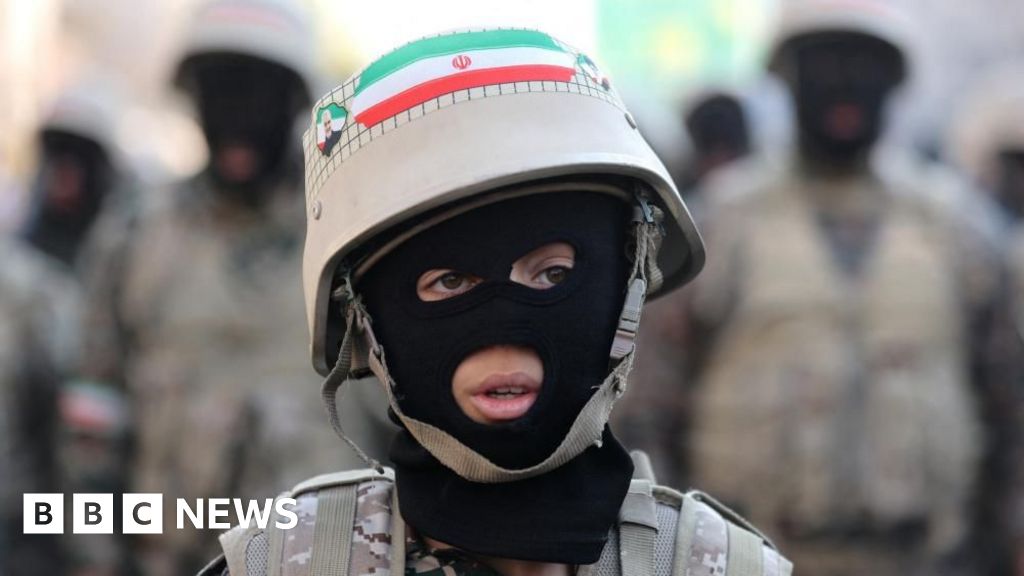
Majid Asgaripour/WANA/Reuters A young person wearing a balaclava, fatigues and a helmet sporting an Iranian flag looks off camera, with blurred military figures in the background.
Majid Asgaripour/WANA/Reuters
A member of Iranian volunteer militia (Basij) attends a march in Tehran in January 2025, before the current war


The death of an 11-year-old Iranian boy reportedly in an air strike while manning a security checkpoint alongside his father in Tehran has thrown focus on a new initiative to recruit children into the security services.


Alireza Jafari's mother Sadaf Monfared told the municipality-run newspaper Hamshahri that the pair had been helping Basij volunteer militia patrols and checkpoints to "maintain the security of Tehran and its people" when they were killed on 11 March.

Last week, an Islamic Revolutionary Guard Corps (IRGC) official in Tehran told the IRGC-affiliated Fars News Agency that the organisation would enrol "volunteers" aged 12 and above.

Eyewitnesses have told the BBC they have seen children, including some armed, in security roles in the capital and other cities.

Foreign-based human rights organisations have also reported Alireza's death. The Kurdish group Hengaw said he was a "fifth-grade student" who was killed while present at a checkpoint in Tehran.

 
Back
Top